
THE RITE OF SPRING
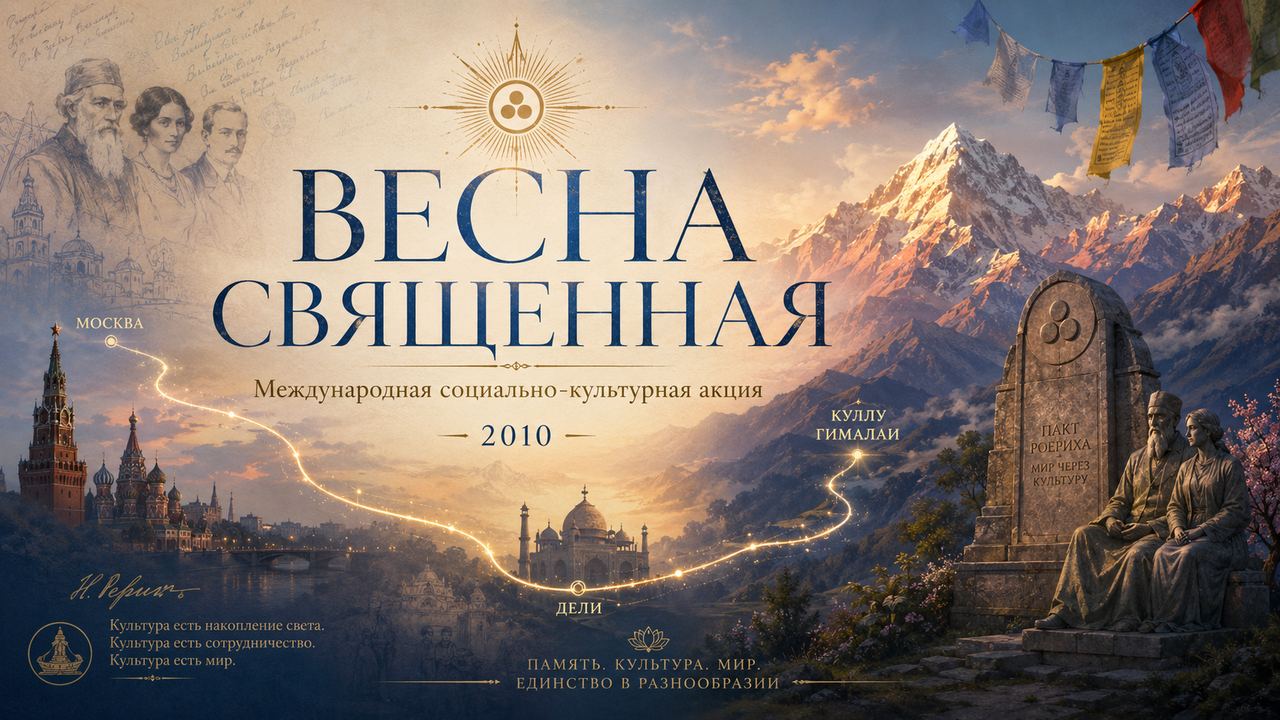
The leadership of the World Alliance “Peacemaker” has the honour to announce a unique social, cultural and historical event of 2010 — the installation of a monument (a memorial sculptural composition) to the Roerich family in India, in the Kullu Valley, at the burial place of the great Russian artist and visionary.
The leadership of the World Alliance “Peacemaker” has the honour to inform you of a unique social, cultural and historical event of 2010 — the installation of a monument (a memorial sculptural composition) to the Roerich family in India, in the Kullu Valley, at the burial place of the great Russian artist and visionary.
This public action, entitled “THE RITE OF SPRING — 2010,” is being prepared through the efforts of many worthy people for whom the spiritual heritage of the Roerich family is a true sanctuary and a source of national pride. We appeal to those who care about Russia’s place in the world, our country’s reputation on the international stage, and its future cultural and spiritual development. “THE RITE OF SPRING — 2010” will take place from 30 April to 15 May along a predetermined route from Moscow to Delhi, and onward — to the foot and the peaks of the Himalayan mountains, with stops at various culturally significant places in India and Tibet. This action will be carried out not only by Russians; we invite all people of goodwill from the most diverse countries of the world to join us and pay tribute to the memory of a mahatma — a great soul who dedicated his entire life to the good of peace. “THE RITE OF SPRING — 2010” is a global creative and socially significant project conducted by the Fund for the Support, Development and Promotion of Peace “Peacemaker” together with the State Duma of the Russian Federation, the international organisation “Federation for Peace and Conciliation,” the Committee on Culture of the State Duma of the Russian Federation, the Committee on Youth Affairs of the State Duma of the RF, as well as the “Pototsky Gallery,” nationwide public organisations — the association “League of Nations’ Health,” the club “The First,” together with the Yuri Rozum Charitable Foundation, the Anita Tsoi Foundation, the charitable foundation “Light of Transfiguration,” and others. We address you with an uncommon proposal, counting on your understanding of the importance and scale of the forthcoming event, and we invite you to take an active part in the cultural life of the planet, to enter the living History of peacemaking on Earth, to leave a vivid mark in the Chronicle of good deeds. Participants in the festival “THE RITE OF SPRING — 2010” represent the most diverse cultural and social strata — schoolchildren, bikers, stars of world pop music, sport, cinema, rock, literature, circus, painting and art as a whole, delegates from every continent of the planet.
The principal task of this cultural and social action and of our peacemaking initiative is to draw international public attention to the problems of preserving peace on Earth; to promote the high ideas of uniting people and nations through art; to discuss, among the creative and political elite as well as representatives of business, the spiritual heritage of the Roerich family in the context of the principal social and humanitarian problems of our time, the trends of Russia’s cultural development on an international scale; to analyse socio-humanitarian processes in the world community through the prism of their ethical, aesthetic and value-based comprehension; and to become acquainted with world traditions directed toward maintaining openness, hospitality, good-neighbourliness and the preservation of peace.
Respectfully, Secretary General
of the “World Alliance Peacemaker”
Yu. Safronov
N. K. Roerich made an outstanding contribution to the culture and art not only of Russia, but of the entire world. Nicholas Roerich and his family dedicated their lives to scientific and educational activity for the good of humankind. N. K. Roerich and his wife E. I. Roerich travelled through the countries of the East, gathering grain by grain the knowledge of different peoples and cultures in the fields of science, spiritual development and art. Their discoveries were reflected in numerous works on ethics, pedagogy, ethnography and anthropology. They actively studied human psychic energy and its possible beneficial influence upon the outer world.
The principal milestones and stages of Roerich’s activity:
1. The project of the Treaty for the Protection of Cultural Property (the Roerich Pact).
The Roerich Pact became the first international act specifically devoted to the protection of cultural property. This document formed the basis of the Hague “Convention for the Protection of Cultural Property in the Event of Armed Conflict,” and the special flag proposed by N. K. Roerich, the Banner of Peace, declaring all treasures of culture and art inviolable, flies to this day over many cultural and educational institutions throughout the world. For his international cultural activity and the initiative of the Pact, in 1929 Roerich was nominated for the Nobel Peace Prize.
“We firmly believe that a final and stable international peace is attainable only through the enlightenment of people and through the constant and impressive advocacy of a brotherhood created by culture, poetry and beauty in all spheres of life. Roerich’s works over the past thirty years have been a great call of people to peace: to love one another” (from the text of the appeal of the committee for the nomination of candidates for the prize)
2. The Central Asian Expedition.
The expedition’s route passed through inaccessible regions of Asia, through unexplored areas of the Transhimalaya, as well as through Sikkim, Kashmir, Ladakh, China (Xinjiang), then Siberia, the Altai, Mongolia and Tibet. Fulfilling the dream of Przhevalsky and Kozlov, Nicholas Roerich’s expedition was a triumph of Russian exploration of Central Asia. By the uniqueness of its route and the materials collected, it rightfully occupies a special place among the greatest expeditions of the twentieth century.
- archaeological and ethnographic research was conducted in unexplored parts of Asia
- dozens of mountain peaks and passes were marked on maps and refined
- rare manuscripts were found
- the richest linguistic materials and works of folklore were collected, descriptions of local customs were made, books were written (“Heart of Asia,” “Altai—Himalaya”)
- about five hundred paintings were created, in which the artist depicted the picturesque panorama of the expedition route; the famous series of canvases “Himalayas” was begun, and more.
3. The creation of the International Cultural Center “Corona Mundi” (“Crown of the World”).
In November 1923 the Nicholas Roerich Museum opened in New York, containing a large collection of the artist’s paintings. Also in New York the Master Institute of United Arts opened, whose principal aim was the drawing together of nations through culture and art. Defining the tasks of the Institute, Roerich wrote:
“Art will unite humanity. Art is one and indivisible. Art has many branches, but the root is one. Everyone feels the truth of beauty. For all, the gates of the sacred source must be opened. The light of art will illumine countless hearts with a new love. At first this feeling will come unconsciously, but afterward it will purify all human consciousness. How many young hearts seek something beautiful and true. Give it to them.”
4. The opening of the Himalayan Research Institute “Urusvati”
On the basis of research obtained during the expedition, in the Western Himalayas, in the Kullu Valley, N. K. Roerich founded the Himalayan Research Institute “Urusvati,” which in Sanskrit means “Light of the Morning Star.”
- medical, zoological, botanical, biochemical and many other laboratories operated at the Institute
- extensive work was conducted in the linguistics and philology of the East
- the rarest written sources of many centuries’ antiquity were collected and translated into European languages; half-forgotten dialects were studied
- invited specialists and temporary staff assembled botanical and zoological collections.
Dozens of scientific institutions of Asia, Europe and America collaborated with the Institute. From Kullu scientific materials were sent to the University of Michigan, the New York Botanical Garden, Punjab University, the Paris Museum of Natural History, Harvard University in Cambridge, and the Botanical Garden of the Academy of Sciences of the USSR. The renowned Soviet botanist and geneticist Academician N. I. Vavilov turned to the Institute “Urusvati” for scientific information and received from there seeds for his unique botanical collection. Outstanding scientists such as Albert Einstein, L. de Broglie, Robert Millikan, Sven Hedin and others also collaborated with the Institute.
5. The creation of a unique philosophical and worldview concept of the structure of the world and of society.
In his philosophical and artistic essays, Roerich created an entirely new concept of Culture, based on the ideas of Living Ethics. Culture, in N. K. Roerich’s view, is closely bound to the problems of the cosmic evolution of humanity. “Culture rests upon Beauty and Knowledge,” he wrote. This is also spoken of in the books of Living Ethics, in the creation of which all the Roerichs took a direct part, but first and foremost Helena Ivanovna Roerich. Helena Ivanovna recorded, and Nicholas Konstantinovich embodied, the ideas of Living Ethics in artistic images.
The tasks that “Peacemaker” sets itself:
- To honour the memory of the Roerich family and to remind the world public of their great contribution to the development of humanity.
- To erect a monument dedicated to their activity in India at the burial place of N. K.
- To create a film dedicated to N. K. and his family, reflecting the principal milestones of his life, creative work, and scientific and educational activity.